Turning waste into opportunity
5th August 2025
How one manufacturer is setting the standard for circular MDF recovery
In manufacturing, waste is often viewed as an inevitable by-product – something to manage, reduce, or dispose of. But in some sectors, we are starting to see a shift, particularly in medium density fibreboard (MDF) production. For decades, MDF has been a reliable and widely used material across the furniture and construction sectors – its versatility and affordability have made it a go-to option for manufacturers and designers alike – but with those benefits comes a growing downside – the waste.
Offcuts, trimmings, rejected boards and end-of-life panels all add up, and unlike some other timber products, MDF is not easily recyclable using traditional methods. The resin binders used in its manufacture complicate disposal, and incineration or landfill has historically been the default option. As regulatory pressure mounts and customers look more closely at sustainability credentials, many manufacturers are being forced to reconsider their approach.
For W Howard, a leading manufacturer of MDF mouldings, this wasn’t just a regulatory issue, it was a practical one. The company was facing increasing volumes of waste and fewer acceptable outlets for it. Costs were rising, but so too were internal questions about whether this was still the right way forward.
The answer came in the form of MDF Recovery’s solution built around an innovative process that separates the wood fibre from the resins in MDF, creating a reusable fibre suitable for new products. W Howard became the first manufacturer to install the MDFR system at operational scale, and while the decision involved due diligence and careful planning, the motivation was straightforward – stop wasting a resource that still has value.
What sets the MDFR process apart is its ability to operate in real factory conditions. It doesn’t require pristine offcuts or tightly controlled input, the system handles standard post-industrial waste – including material with coatings or laminates – and separates out clean, dry wood fibre. That fibre has already found applications in the insulation market and is being tested for other potential uses.
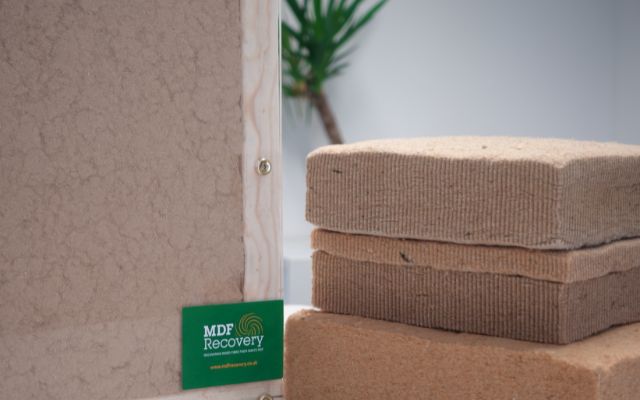
W Howard is going to produce a new insulation material called Pillo, made using the recovered fibre from its MDF waste. The Pillo product range is designed for thermal and acoustic insulation and is already being adopted in construction and packaging. In doing so, the company has turned a disposal cost into a revenue stream – a rare example of true circularity in action.
MDF Recovery offers a turnkey solution, with systems tailored to each customer’s waste volumes and facility requirements. Depending on site scale, installations can be configured to handle 2 tonnes or 5 tonnes of MDF waste per hour. In W Howard’s case, the system has been specified to fit within their operational footprint and existing process flow.
While the technology itself is novel, the implications are more familiar- it mirrors the logic seen in other industries where by-products become secondary income streams. From spent grain in brewing to textile offcuts in fashion, waste is increasingly being viewed through a commercial lens.
In this context, MDF is late to the party – but perhaps with good reason, because recycling it has always been more complex, and solutions have been slow to materialise. What the W Howard project shows is that with the right technology, that complexity can be overcome. And once it is, the business case follows naturally.
The conversation around sustainability in manufacturing often focuses on what should be done in the future. But this is a rare example of a circular solution being implemented now – not in a pilot scheme or research lab, but on the factory floor.
This shift may not make headlines, but it matters – even if a fraction of the 1 million tonnes of MDF waste generated in Europe each year could be recovered and reused, the environmental and economic benefits would be substantial.
The industry has long needed a practical answer to the MDF recycling problem, and now that it exists, the question becomes how many others are prepared to follow. Contact Rob Elias rob.elias@mdfrecovery.co.uk.